

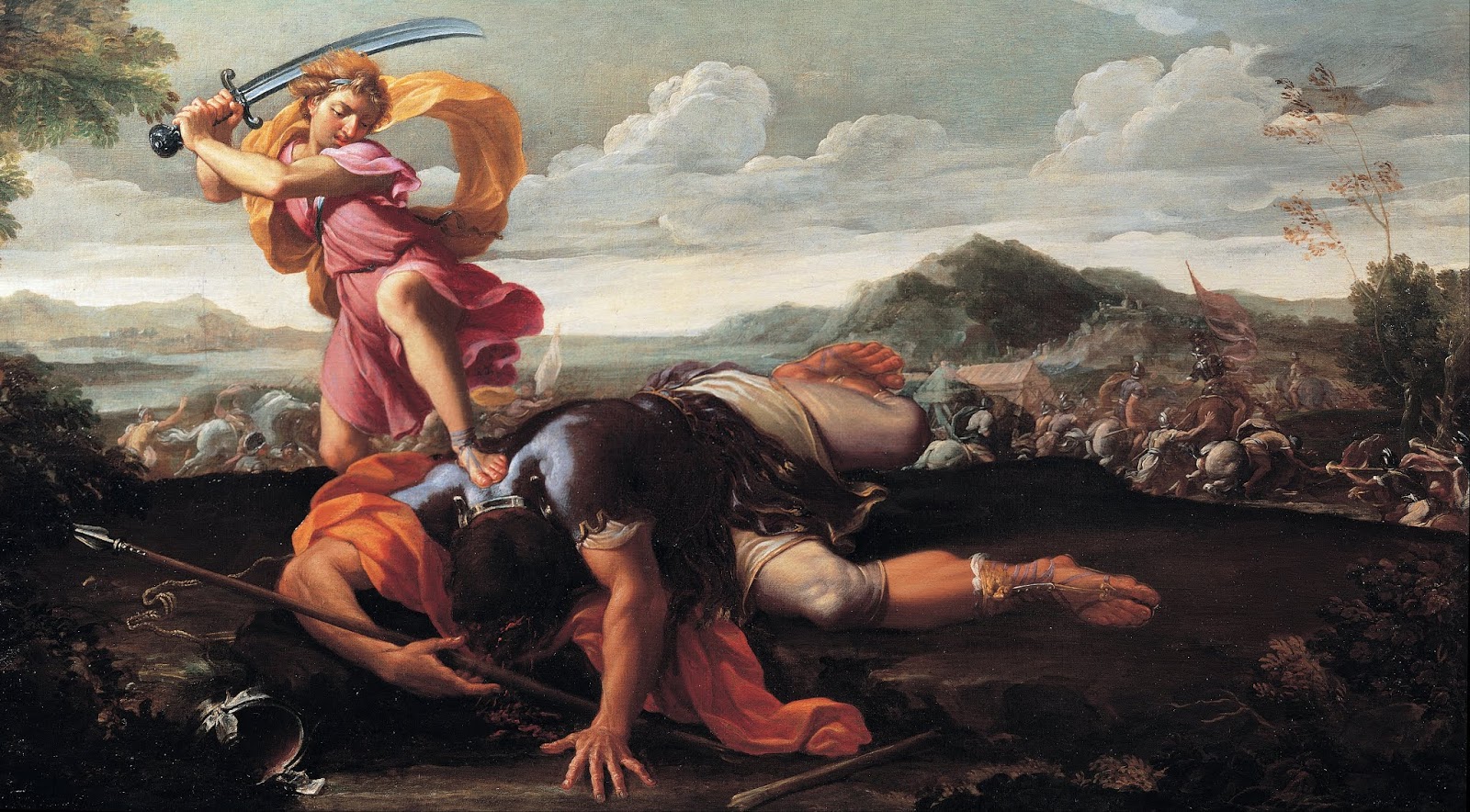
You see, the next story is one of David and Goliath, where—after David volunteers to fight the giant—we learn that neither Saul nor Abner has any clue about David’s identity or the identity of his father! Indeed, rather than having been sent to stay with Saul (as 1 Sam 16 relates), David has been staying with his father’s sheep while his brothers serve in the army and has never been seen by anyone in the army or around the king until now (1 Sam 17.55–58)! He is not known as a warrior, not as a harp player, not as part of Saul\’s court, and not even as the son of his father, but merely a brave lad.

Now, you’ve probably noticed in the footnotes of your Bibles a few places where they say “The Hebrew is unclear” or “the Greek reads…” (e.g., 1Sam 1.5; 6.19; 13.1; 27.5–7; 2 Sam 13.22, 28; 21; 24.12–14; et al!). Depending on the situation, the implications range from minor (three vs. seven years of famine) to major (God killing 75 or 50,075 people), to theological (whether David is sacrificing Michal’s or Rizpah’s sons!). In this case, however, the differences are much larger in scope.
- David stays at Saul’s court after being made his armor-bearer rather than returning home
- Saul knows who David throughout the story (this explains why he would let him fight; there is no second meeting; it explains why David is with Saul / gets an audience with him)
- It heightens the armor bearer vs. armor bearer and other narrative aspects of Samuel\’s situation
- (And, although not a focus of this, you’ll also note that the Greek Text changes Goliath’s height significantly!)
 The difference in this story is hefty: the Greek text is missing about 25 verses from what is in our ~50-verse Hebrew text—and that’s just from one chapter! Indeed, if we look through the rest of Samuel we find lots more situations where events are out of order, where things are added, and where small sections / questions of specifics are different. But it’s not just Samuel: there are enormous differences in length (and sometimes theological developments) in lots of other books of the Hebrew Bible, especially Job (1/6 shorter in the OG) or Jeremiah (15% shorter in the OG) that are at least equal to Samuel. And that isn’t counting all of the different, smaller but still important, areas of change!
Our English Bible give undue preference to the Hebrew Text of the Hebrew Bible / Old Testament (HBOT). These reasons are understandable, but severely outdated. Although it’s true that the Hebrew version of the HBOT is older than the Greek, it is not true that the Hebrew text which underlies our Bibles is older than the Greek text we have in the Old Greek and Septuagint versions. In fact, quite the opposite. This recognition–and there is overwhelming proof for much of this, ever since the dissemination of the Dead Sea Scrolls (DSS)–should drive us to place the Greek texts on (at least!) equal footing with the Hebrew. We should take these questions more seriously, and we should start looking more closely at those footnotes in our Bible or reading the NETS. It’s amazing what you’ll pick up, if you do.
 Ben Neviim
2 thoughts on “When David met Saul: Contradictions, the OG, and the MT”