Theology of Exodus in Kings: Solomon’s Pharaonic Shadow


YORAM RAANAN “Crossing the Sea”

Ron Hendel notes, “The exodus from Egypt is a focal point of ancient Israelite religion. Virtually every kind of religious literature in the Hebrew Bible—prose narrative, liturgical poetry, didactic prose, and prophecy—celebrates the exodus as a foundational event. Israelite ritual, law, and ethics are often grounded in the precedent and memory of the Exodus. … In its existential actuality, the exodus, more than any other event of the Hebrew Bible, embodies William Faulkner’s adage: ‘The past is never dead. It’s not even past.’” Michael Fishbane said it this way, “The exodus tradition was used, from the first, as a paradigmatic teaching for present and future generations.” They’re right.

But how do we find the Exodus? Sometimes, it’s simple! There will be a direct quotation of something that arises from the Exodus, or else there will be explicit mention of the Exodus (for example, in a later post when we talk about 1 Kings 17, we can see the story of the Exodus explicitly referenced). But, most of the time, the Bible–like most good literature–doesn’t provide explicit citations but rather reuse of themes, vocabulary, and imagery: you don’t prove that O Brother Where Art Thou? is a retelling of Homer’s Odyssey through citation; you don’t demonstrate that The Mandalorian is a Western through quotation; you can’t show that The West Side Story is Romeo and Juliet by its explicit references to Shakespeare. In each of these cases, you must focus on the vocabulary, the typology, the story progression, and the “genre markers” to make these identifications. In other words: intertextuality.

After reading just this and seeing the focus on storage cities (the first time this term has been used in the text since Exodus!), we might say Dayenu! But wait, there’s more! Solomon also builds a fleet of ships that he anchors at the Red Sea (1 Kgs 9.26), and the goes down to Egypt in order to gain horses and chariots and gold (1 Kgs 10.14–29), the very things that God told his kings not to do (Dtr 17.14–20). Solomon, like the Israelites in the Wilderness, seeks to return to Egypt. And, like those same Israelites, he worships false gods and builds high places for idolatrous sacrifices (1 Kgs 11.1–8).

And comparisons go deeper, still, for when we read 1 Kgs 11.14–22, we read about Solomon (and, admittedly, David’s!) relationship of Hadad the Edomite whom God raised up against Solomon and who we read about as a young man from another nation who was nearly killed at birth but escaped to Egypt and joining Pharaoh’s family while most of the other males of his nation were killed by a wicked king seeking to keep them from rebelling or joining their military enemies (11.14–22). It is no surprise that, when the Israelites remember Solomon’s reign, it is that he “made their yoke heavy” and “disciplined them with whips” (1 Kgs 12.10–11)—the very things that Pharaoh did.

Solomon began to build the temple for the LORD in the four hundred eightieth year after the Israelites came out of the land of Egypt, in the fourth year of his reign over Israel, in the month of Ziv, which is the second month…

1 Kings 6.1

This text, which has often been used to date the Exodus (Ralph Davis notes that “these texts are frequently used for calculating chronology rather than understanding redemption”) to the exclusion of recognizing that building the temple is what concludes the Exodus: the movable tabernacle has found a permanent home; and the wilderness wandering has come to an end. This explicit “name dropping” or use of the Exodus vocabulary is intensified when Solomon again connects the completion of the temple to the completion of the Exodus experience: “Blessed be the LORD who has given rest to his people Israel according to all that he has promised. Not one word has failed of all his good promises, which he spoke by Moses his servant” (1 Kgs 8.56).

After reading just this and seeing the focus on storage cities (the first time this term has been used in the text since Exodus!), we might say Dayenu! But wait, there’s more! Solomon also builds a fleet of ships that he anchors at the Red Sea (1 Kgs 9.26), and the goes down to Egypt in order to gain horses and chariots and gold (1 Kgs 10.14–29), the very things that God told his kings not to do (Dtr 17.14–20). Solomon, like the Israelites in the Wilderness, seeks to return to Egypt. And, like those same Israelites, he worships false gods and builds high places for idolatrous sacrifices (1 Kgs 11.1–8).

And comparisons go deeper, still, for when we read 1 Kgs 11.14–22, we read about Solomon (and, admittedly, David’s!) relationship of Hadad the Edomite whom God raised up against Solomon and who we read about as a young man from another nation who was nearly killed at birth but escaped to Egypt and joining Pharaoh’s family while most of the other males of his nation were killed by a wicked king seeking to keep them from rebelling or joining their military enemies (11.14–22). It is no surprise that, when the Israelites remember Solomon’s reign, it is that he “made their yoke heavy” and “disciplined them with whips” (1 Kgs 12.10–11)—the very things that Pharaoh did.

After reading just this and seeing the focus on storage cities (the first time this term has been used in the text since Exodus!), we might say Dayenu! But wait, there’s more! Solomon also builds a fleet of ships that he anchors at the Red Sea (1 Kgs 9.26), and the goes down to Egypt in order to gain horses and chariots and gold (1 Kgs 10.14–29), the very things that God told his kings not to do (Dtr 17.14–20). Solomon, like the Israelites in the Wilderness, seeks to return to Egypt. And, like those same Israelites, he worships false gods and builds high places for idolatrous sacrifices (1 Kgs 11.1–8).

And comparisons go deeper, still, for when we read 1 Kgs 11.14–22, we read about Solomon (and, admittedly, David’s!) relationship of Hadad the Edomite whom God raised up against Solomon and who we read about as a young man from another nation who was nearly killed at birth but escaped to Egypt and joining Pharaoh’s family while most of the other males of his nation were killed by a wicked king seeking to keep them from rebelling or joining their military enemies (11.14–22). It is no surprise that, when the Israelites remember Solomon’s reign, it is that he “made their yoke heavy” and “disciplined them with whips” (1 Kgs 12.10–11)—the very things that Pharaoh did.

Solomon made an alliance with Pharaoh king of Egypt by marrying Pharaoh’s daughter. Solomon brought her to the city of David until he finished building his palace, the LORD’s temple, and the wall surrounding Jerusalem. However, the people were sacrificing on the high places, because until that time a temple for the LORD’s name had not been built. Solomon loved the LORD by walking in the statutes of his father David, but he also sacrificed and burned incense on the high places.

1 Kgs 3.1–3

After reading just this and seeing the focus on storage cities (the first time this term has been used in the text since Exodus!), we might say Dayenu! But wait, there’s more! Solomon also builds a fleet of ships that he anchors at the Red Sea (1 Kgs 9.26), and the goes down to Egypt in order to gain horses and chariots and gold (1 Kgs 10.14–29), the very things that God told his kings not to do (Dtr 17.14–20). Solomon, like the Israelites in the Wilderness, seeks to return to Egypt. And, like those same Israelites, he worships false gods and builds high places for idolatrous sacrifices (1 Kgs 11.1–8).

And comparisons go deeper, still, for when we read 1 Kgs 11.14–22, we read about Solomon (and, admittedly, David’s!) relationship of Hadad the Edomite whom God raised up against Solomon and who we read about as a young man from another nation who was nearly killed at birth but escaped to Egypt and joining Pharaoh’s family while most of the other males of his nation were killed by a wicked king seeking to keep them from rebelling or joining their military enemies (11.14–22). It is no surprise that, when the Israelites remember Solomon’s reign, it is that he “made their yoke heavy” and “disciplined them with whips” (1 Kgs 12.10–11)—the very things that Pharaoh did.

This is the account of the forced labor that King Solomon had imposed to build the LORD’s temple, his own palace, the supporting terraces, the wall of Jerusalem, and Hazor, Megiddo, and Gezer… And all of the storage cities (עָרֵ֤י מִסְכְּנוֹת֙) that belonged to Solomon, his horse and chariot cities, and whatever Solomon desired to build in Jerusalem, Lebanon, or anywhere else in the land of his dominion.

1 Kgs 9.15–19

After reading just this and seeing the focus on storage cities (the first time this term has been used in the text since Exodus!), we might say Dayenu! But wait, there’s more! Solomon also builds a fleet of ships that he anchors at the Red Sea (1 Kgs 9.26), and the goes down to Egypt in order to gain horses and chariots and gold (1 Kgs 10.14–29), the very things that God told his kings not to do (Dtr 17.14–20). Solomon, like the Israelites in the Wilderness, seeks to return to Egypt. And, like those same Israelites, he worships false gods and builds high places for idolatrous sacrifices (1 Kgs 11.1–8).

And comparisons go deeper, still, for when we read 1 Kgs 11.14–22, we read about Solomon (and, admittedly, David’s!) relationship of Hadad the Edomite whom God raised up against Solomon and who we read about as a young man from another nation who was nearly killed at birth but escaped to Egypt and joining Pharaoh’s family while most of the other males of his nation were killed by a wicked king seeking to keep them from rebelling or joining their military enemies (11.14–22). It is no surprise that, when the Israelites remember Solomon’s reign, it is that he “made their yoke heavy” and “disciplined them with whips” (1 Kgs 12.10–11)—the very things that Pharaoh did.

As Peter Leithart notes in his extraordinary (and equally frustrating) commentary on the book of Kings, “Solomon begins acting like a Pharaoh, not only in the obvious sense that he builds stables for his horses and chariots but also in that he builds “cities of storage”, a phrase used elsewhere only in Exodus where the Hebrews built for Pharaoh cities of storage, Pithom and Raamses. Solomon returns Israel to an Egyptian-like state, setting up for the ‘Mosaic’ liberation of the Northern Tribes under Jeroboam.”

The connections then to the Exodus in 1 Kgs 1–14 in the reign of Solomon are strong. And I’m not nearly the only person who has noticed them! Numerous scholars have pointed elements of these same readings out in their commentaries and articles and that’s not surprise when we have explicit connections to the Exodus in the text linking the Temple, rare verbal connections to Pharaoh’s practices, and numerous narrative “markers.” It’s hard to get away from Amos Frisch’s conclusion that “The Book of Kings… likens Solomon to Pharaoh.” But the story does not end there, for in that same context Frisch notes what we might already suspect: that if Solomon is a New Pharaoh, then perhaps God might raise up in Jeroboam a new Moses.

But for that, we’ll have to wait until next time…

Reading Thematically: Trees of Life and Death

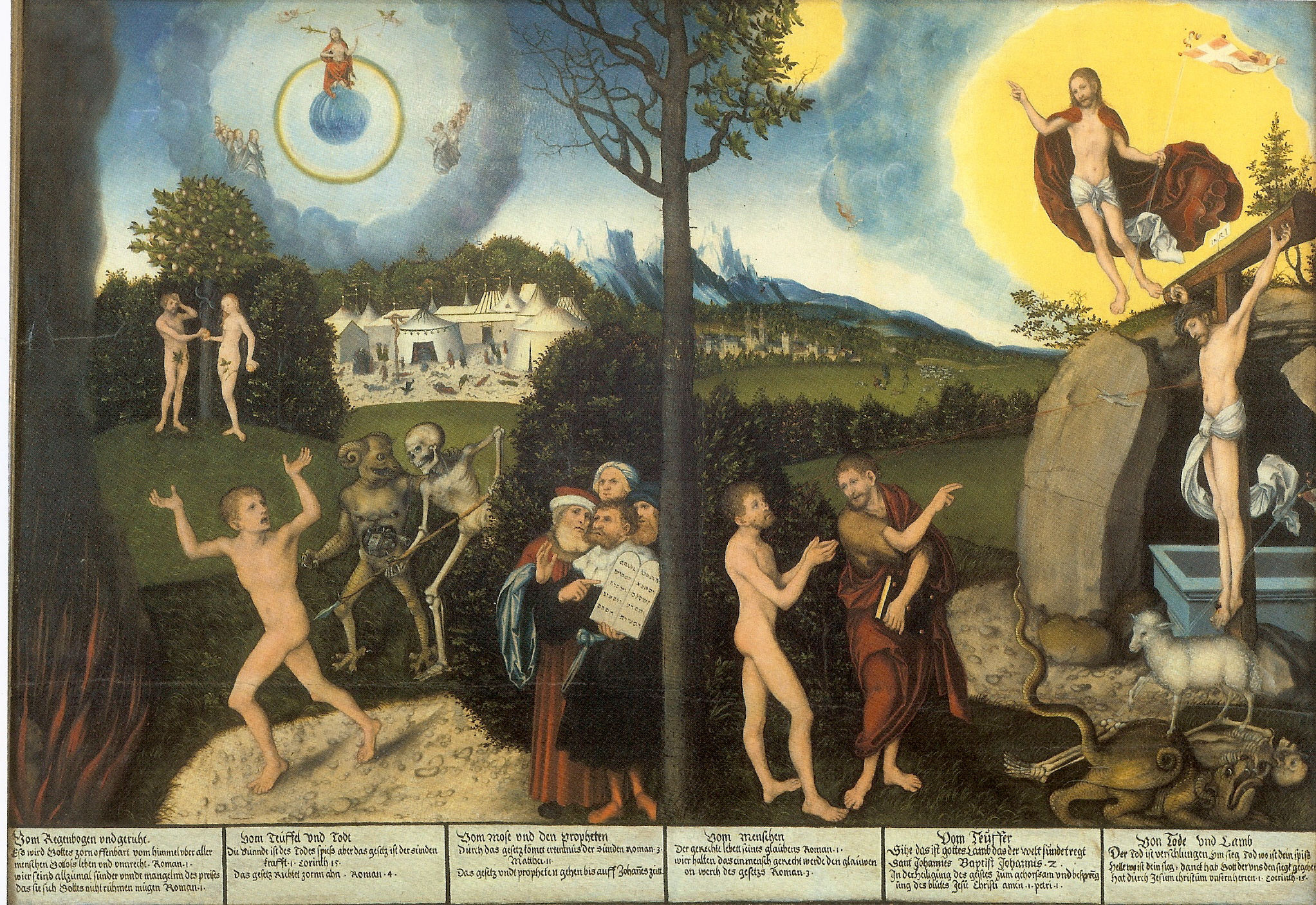
Even when my siblings and I were younger, our parents would take us to art museums. A lot. (Yes, we were homeschooled.) I remember some of those trips where I wasn’t quite sure what was going on and I certainly recognize that some pieces were easier to appreciate and “like” than others. My confusion, however, was (comparatively!) short lived: we studied art history, we learned about da Vinci and Donatello and Michelangelo and Raphael. This did two things: instilled a love for Renaissance art in me that you probably have noticed in my picture selection on the blog (or in my classes and PowerPoints!), and my love of the Ninja Turtles (which I don’t think we were technically allowed to watch as children. Did I mention I was homeschooled?).

But as I learned more about art, whether we’re talking about ancient Greek sculpture or Byzantine Christian art or modern art, the more I learned to appreciate it. In his book on reading the Bible as art (in this case, literature), Robert Alter explains that reading art well is based on:

…an elaborate set of tacit agreements between artists and audience about the ordering of the artwork is at all times the enabling context in which the complex communication of art occurs. Through our awareness of convention we can recognize significant or simply pleasing patterns of repetition, symmetry, contrast: we can discriminate between the verisimilar and the fabulous, pick up directional clues in a narrative work, see what is innovative and what is deliberately traditional at each nexus of the artistic creation (The Art of Biblical Narrative, 55).

Or, if you want the readers’ digest version: art only works when we get what it’s doing and the more we know about what it\’s doing, the more likely we are to appreciate it. But this isn’t true only of paintings or sculpture or architecture; it’s also true of literature and film and all sorts of other creative endeavors, including the Bible.

One of the ways that reading the Bible as literature is that we can and should learn to recognize some of these “tacit agreements” and better uphold our end of the deal. A few of the ways that we can do this is by recognizing intertextuality, recognizing type scenes, or by reading thematically. I’ve talked about intertextuality and type scenes in the past, so let’s take a look at what I mean by themes today and look at a single image from the Bible: Trees.

Trees are part of our everyday lives and, unless we’re arborists, we probably don\’t give them too much thought. But a quick consideration of how trees work in the Bible reveals that we have quite a few stories where trees play a significant role in the narrative: the Garden of Eden has the Tree of Life (Gen 2–3); Moses is confronted by a burning bush in the wilderness (Exd 3–4); the tabernacle houses lampstand in the shape of a tree which also burns (Exd 25.31–40); and the righteous are compared to trees (Psa 1.3–4). On the opposite side of things, the Garden also plays host to the Tree of Knowledge of Good and Evil (Gen 2–3), and those who partake of its fruit are cursed, as are those who are hung on trees (Dtr 21.33; 2 Sam 21.1–6; Est 5–7); idols are made from and placed under trees (Dtr 16.21; Jgs 6; 1 Kgs 14.23; 16.33; 2 Kgs 16.4; Isa 44.9–20); and, most famously of all in Christian tradition, Jesus is crucified on a tree (make sure to read Peter William\’s thread on “Tree“!). Now, I\’m not the first person to have picked up on some of these concepts. Indeed, many go back all the way to the Church Fathers! But, I think the Bible Project does a great job of summarizing some of this in a quick video. I’d encourage you to check it out, now!

But let’s see if we can go a bit further.

What we see when we consider these stories is that trees in the Bible fit in one of two categories: they either give life or they give death. But it’s more than just that. It\’s that the life that the “good” trees provide is life tied to being made in the image of God and receiving life from him and the death the “bad” trees provide is death tied to becoming gods and ruling your own world. This remains consistently (if not constantly!) true.

When the Serpent comes and offers Adam and Eve the tree, he offers them the temptation of godhood: “You will not surely die. For God knows that when you eat of it your eyes will be opened, and you will be like God, knowing good and evil” (Gen 3.1–7), but their eating results in a curse for man (Gen 3.17a, 19), woman (Gen 3.16), the serpent (Gen 3.1–15), and the ground itself (Gen 3.17b–18). They are expelled from the Garden into a wilderness. Later, when the Israelites are in bondage and death in Egypt, God meets with Moses in the wilderness to offer to bring Israel back from exile and into a New Garden with new life, and shows this with a contrary image: a tree that will not be consumed by fire (Exd 3–4), life defying death (the very point Jesus makes in Luke 20.37–38). But Israel, throughout its history, consistently does as Adam and Eve did–they chose to try and become gods who rule their own world. They set up Asheroth which are goddesses represented by tree (this is actually more complicated than that, but we don\’t have time to go into it right now!) (Dtr 16.21; Jgs 6; 1 Kgs 16.33), they place idols on top of “evil hill and under every tree” (1 Kgs 14.23; 2 Kgs 16.4) and carved their idols out of trees (Isa 44.12), and–in the mind of many of the biblical writers–this was because they wanted to become gods themselves rather than submit to YHWH. It\’s for this reason that those who hang on trees (rather than receiving proper burial) are cursed and leaving them hanging curses the land (Dtr 21.33; cf. 2 Sam 21.1–6), because eating from the tree brought a curse on the land (Gen 3.17–19)!

If you look carefully, you can see that the connections between the trees plays a key role in this art as well!

But that dichotomy of life and death illustrated on top of Mt. Sinai is also present in the Gospels and helps answer a question that I sometimes ask my students to answer: Why did Jesus have to die on a Cross? There were lots of other deaths that he could have died, at different times and in different ways; would not any of them have brought a cleansing from sins? Not according to Paul, who says:

Christ redeemed us from the curse of the Law, having become a curse for us—for it is written, “Cursed is everyone who hangs on a tree”—in order that in Christ Jesus the blessing of Abraham might come to the Gentiles, so that we would receive the promise of the Spirit through faith (Gal 3.13–14).

Or, to put it differently, if we read the idea of trees throughout Scripture thematically, we might say:

Through sin on a tree, humanity chose to become gods themselves (Gen 3.1–7), and brought on death and exile and destruction for themselves and for the world. Through sin on a tree, humanity  again chose to become gods themselves (Mat 21.33–46), and sacrificed the Son on a Cross, and brought on life and restoration and renewal to themselves and the world.

Christ on the Cross is YHWH in the Burning Bush: burning but not burned up, killed but not saying death, so that death might be swallowed up by life. For the only way to reverse the curse that came on humanity and the world when we ate of the fruit of the cursed tree was to sacrifice Jesus upon it and thus gain access, once again, to the Tree of Life (Rev 2.7; 22.1, 14, 19).

Taxes and Death: Incarnation and Subversion (Luke 2)

Jesus’ birth was a deeply subversive affair in at least a few ways. Last time, we looked at how Luke and the angels subvert Roman authority and emperor cult, but the Incarnation was also deeply subversive to Jewish hopes and expectations, particularly for national hopes of rebellion.

This subversion of expectations and hopes comes from two areas, both found in Luke 2. The first is the historical context of a census and the second comes from the angelic statement of peace.

We know that Jesus is born in Bethlehem to fulfil prophecy, but the reason that Jesus was in Bethlehem to be born is probably even more important to Luke’s narrative as that prophetic fulfilment:

In those days a decree went out from Caesar Augustus that all the world should be registered. This was the first registration when Quirinius was governor of Syria. And all went to be registered, each to his own town (Luke 2.1–3).

“But how can a census be as important as fulfilled prophesy!?” you might ask. That’s a good question. First off, we should note that (unlike in Matthew!), Luke does not emphasize the Bethlehem connection. But he does emphasize the census and he does this not just by mentioning it, but by subverting the expectations that come along with it.

Now, we may read “census” and not think too much of it. Or, if you do, it’s probably to get all caught up in the historical discussions revolving around the date (after all, the discussion about how exactly you get Luke’s narrative, Herod’s death, and Quirinius’ census to line up tends to suck up all of the oxygen in the room). But, for Luke, it’s not the date of the Census that is so important, but the context.

Under Augustus, provincial censuses like the one we read about in Luke were organized by the central government for the first time. For provincial areas which were more rural than urban, like Judea or Gaul, this meant additional government interference in your normal life and tended to proceed additional taxation. Taxes have never been popular. In fact, taxes in the Roman Empire and the censuses which introduced them were so unpopular that censuses were frequently the cause of revolts in the further provinces. There were Gallic Revolts which were kicked off by taxes in 27 and 12 BC as well as in AD 14 and 61.

And, although we may not know it, there was one kicked off in Judea by Quirinius’ census in AD 6 as well.

Josephus tells us,

Under the administration [of Coponius and Quirinius], a certain Galilean whose name was Judas, prevailed with his countrymen to revolt and said that they were cowards if they would pay taxes to the Romans and would, after God, submit to their mortal men as their lords. (Wars, 2.117–18; cf. Ant. 18.1–10 for a fuller account).

And while we might not be aware of either Josephus’ account or Judas’ rebellion, Luke was; he specifically mentions it in Acts “After him Judas the Galilean rose up in the days of the census and drew away some of the people after him” (Acts 5.37).

But it’s not just Luke that was aware of Judas’ revolt or the expectation that censes would lead to rebellions. Not was Luke the only one who knew that “Messiah” and “Rebellion against Rome” were frequently tied together in the context of 1st century Judea. If the Messiah was to bring about a kingdom, that kingdom must overthrow Roman power. So it shouldn’t surprise anyone that, as Josephus also tells us, as Jewish men declared themselves to be Messianic figures, they tied such claims to rebellion against Rome.

And, at first, this seems to be what we get with Jesus’ birth (and later life as well). An army of angels attends Jesus birth (Luke 2.13) and we’ve already been reminded that he’s a son of David (Luke 2.4). Later, as he becomes more famous and the Messianic hope intensifies, he goes into Jerusalem and people lay their cloaks down before him and spread palm branches at him and talk about how the blessing of the kingdom of David is coming, they mean war and rebellion (Luke 19.28–40; cf. Mark 11.8–10).

And yet, at every moment, Jesus subverts these hopes for an earthly Jewish kingdom. Although he, like the Maccabees, has palm fronds waved at him (2 Mac 10.1–7; Luke 19.28–40), and although he, like the Maccabees, would cleanse the temple in an act of Channukah-like defiance (1 Mac 4.36–61; 2 Mac 10.1–10; Luke 19.45–48), he does not follow in the Maccabean modus of rebellion and even his temple cleansing subverts the expectations of violence. And, as you read further in Luke, you realize that the reason that—less than a week after laying out their robes for Jesus’ triumphal entry—the Jerusalemites reject Jesus and send him to death and call out “give us Barabbas!” is because they recognized that Jesus would not fight against the Romans and that Barabbas would, for he was an insurrectionist (Luke 23.18–24).

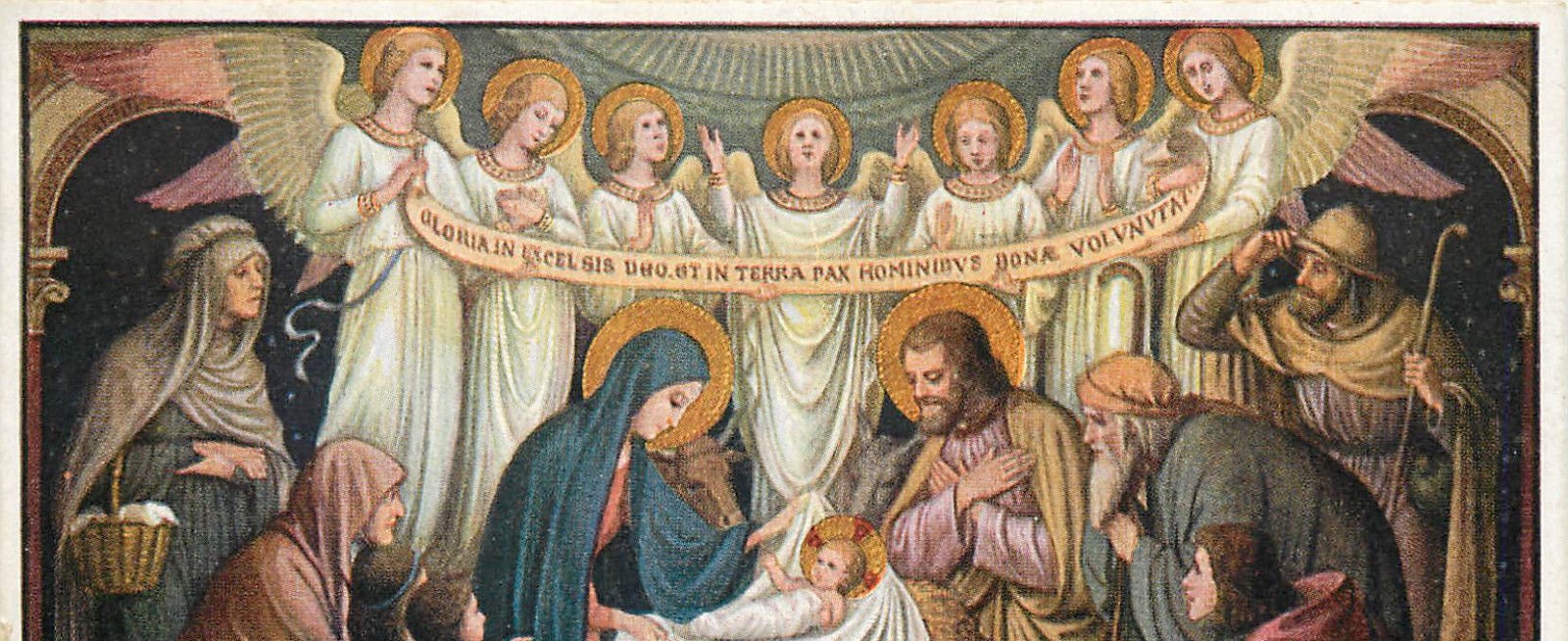
But what we see at the end of Luke and what we see in the Cross, we see prefigured in the Cradle. When a census is enacted by a wicked empire, an army of angels comes to the king in a manger and proclaims “Peace on earth,” a hope that is lost when Jesus is rejected, and a hope that is itself subverted at the Triumphal Entry, where we hear proclaimed “Peace in Heaven” (Luke 19.38 = Psa 118.26). No more will there be peace on earth (Luke 19.41–44) because they have rejected the Prince of Peace and sent their king to a Cross. The Cross is prefigured in the Cradle.

Too often, at least in my tradition, our rejection of Christmas as a religious holiday tends to lead to a rejection for the appreciation for and close reading of, the Incarnation itself. But if you read Luke (as well as the other Gospels, but I know Luke best), you will find in the Incarnation the same story that you will find elsewhere. That here in the manger, surrounded by Angels, we find Cradle, Crown, and Cross.

Gods, Angels, and Emperors: Subversion and Incarnation (Luke 2)

Jesus’ birth was a deeply subversive affair. In the midst of the proclamation of peace is implied an announcement of rebellion. Luke demonstrates this in several ways, but one of the most obvious is that the annunciation of the angels served as a direct assault upon the power of the Roman Emperor. Let’s review!

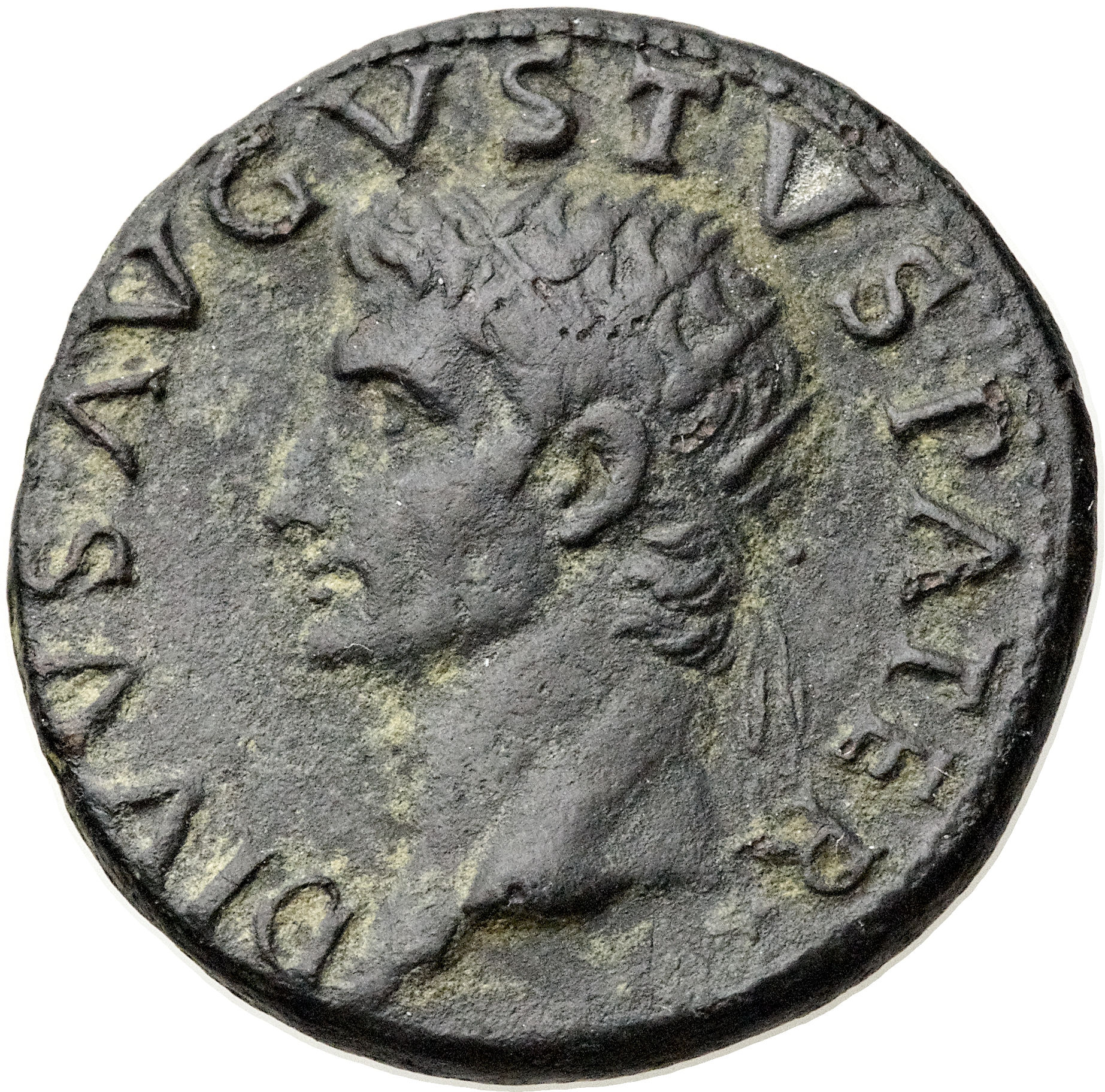
When Augustus was finally crowned in 9 BC, the assembly explains their reasoning thus:

Divine providence which orders our lives created with zeal and magnificence the most perfect good for our lives when it produced Augustus and filled him with virtue for the benefaction of humankind, sending us and those after us a savior who put an end to war and established all good things! Augustus appeared and exceeded the hopes of all who had anticipated good tidings, not only by surpassing the benefactors before him, but not even leaving those to come any hope of surpassing, so the birthday of a god marked for the world the beginning of good tidings through his coming (from Lewis and Reinhold, Roman Civilization 2:64).

This speech, which was given at Augustus’ birthday and proposed the creation of the new beginning of the year:

It’s hard to say whether the birthday of the most divine Caesar is a matter of greater pleasure or benefit. We could fairly say it is a new beginning of all things and he has restored all things—perhaps not to our natural state since everything has become imperfect and fallen to misfortune and would have simply embraced self-destruction had not Caesar been born for their common benefit—a breath of new life for all! . . . Thus all people should see to celebrate his birthday, that of the most divine Caesar, and thus it shall be New Years Day for all citizens.

You can imagine the context of this (typical!) proclamation. Provided by a Roman Governor in Asia Minor, it was a steppingstone in the Emperor Cult which would become so important for the book of Revelation, but is already present, here. Caesar carefully portrayed himself as the son of a God and as a Savior. He and his supporters presented the emperor’s birth as beginning a new era, one which would bring peace and benefaction and renewal to all things.

It’s in this context that Christ was born and—once we’ve been acculturated to the images of Caesar’s birth—the comparisons are hard to miss! Caesar’s birth is celebrated with pomp and circumstance, dignitaries and sycophants arrayed in a grand parade come to pay honor to him whom honor was certainly due, and while there, arrayed in his royal garb, he is presented praise and even worship. Contrasted to that is Christ’s birth, which is itself celebrated with familial joy, but the human court which surrounded him were society’s lowest members (shepherds), and they saw him arrayed only in wrapped in strips of cloth, his throne a manger. Of course, this humble image is itself subverted by visiting dignitaries, this time of the angelic sort, who appear with a heavenly army and announce:

Glory to God in the Heavenly Places!
Peace on Earth for the People He Favors! (Luke 2.14).

Here we have again a repeated theme in Luke–Acts: Christ is Lord, and Caesar is not. In the days where Augustus Caesar reigns and his census seems to move Mary and Joseph where he wills, it is only accomplishing the will of God that he might be born in Bethlehem to fulfil prophecy (Luke 2.1–7). In the time of Tiberius Caesar rules with a Roman governor over Judea, the coming of her true king is proclaims (Luke 3.1–6). And that king is not just a son of David and King of Judea (as he is in Matthew’s account), but also a son of Adam and Son of God and thus king of the World (Luke 3.23–28). We could talk about more (and I will in another blog post!) but even just this should make something clear: Luke wrote to purposefully show that the Kingdom of God was opposed to all of the kingdoms of the Earth and Jesus’ birth announced the coming of a new king and a new kingdom, which would seek to and ultimately destroy all of the powers currently in play (Herod, of course, realizes this and tries to kill him!). Jesus’ birth and the Incarnation itself, is subversive and rebellious to the powers of the world, both for Caesar and for Satan.

Those announcing at Caesar’s birthday were right: a new beginning was coming, one to which nothing before or afterwards would be able to compare, a new breath of life, a Savior and a God was born. They were just a few years early and focused on the wrong person.

Too often, at least in my tradition (but even in traditional modern readings), our rejection of Christmas as a religious holiday tends to lead to a rejection for the appreciation for and a close reading of the Incarnation itself. But if you read Luke (as well as the other Gospels, but I know Luke best), you will find in the Incarnation the same story that you will find elsewhere. At the beginning we have the question presented: Who is your true King? At the end, at least for some, we have the answer made clear: “We have no king but Caesar.” Here in the manger, surrounded by Angels, we find the story of Jesus as a whole: Cradle, Crown, and Cross.

Four Gospels; One Jesus: Reading Vertically

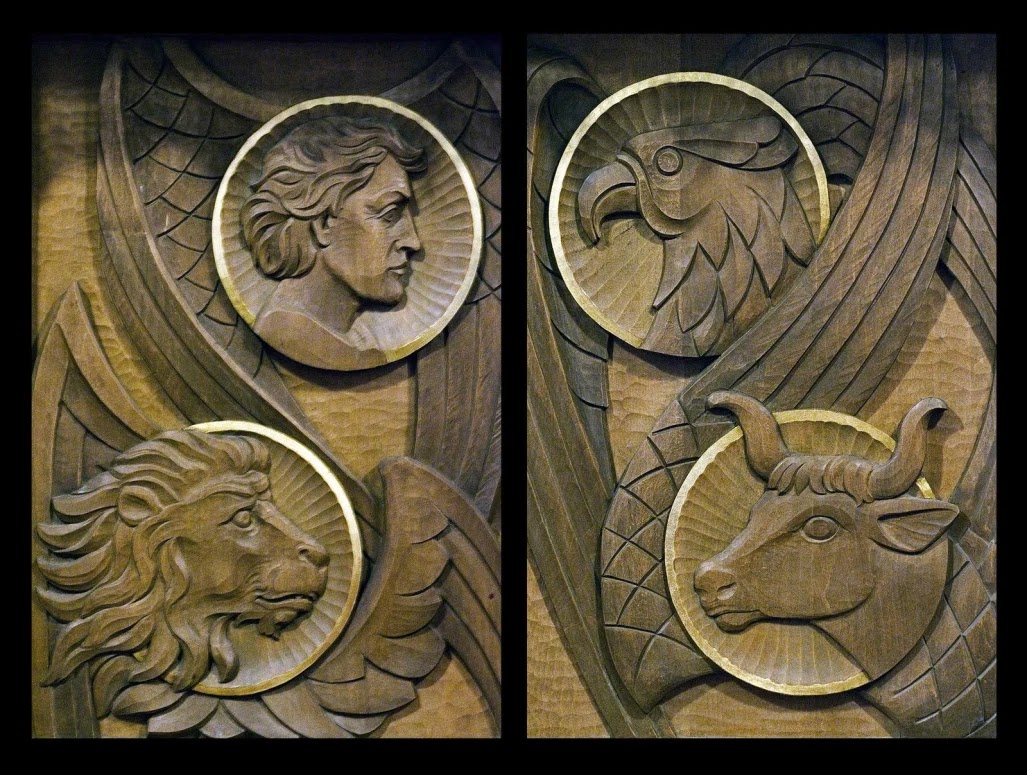
 \”…the first living creature like a lion, the second living creature like an ox, the third living creature with the face of a man, and the fourth living creature like an eagle in flight\” (Rev 4.7)

Each of the four Gospels—Matthew, Mark, Luke, and John—draw their own, inspired portrait of their Lord and Savior, Jesus Christ. Each of these four Gospels provides insight into who the Son of God was, what he did, and why that matters. For those who believe in Inspiration, God provided the Church with four Gospels rather than a single one. For those who don\’t believe in inspiration, the Church chose to select, copy, and propagate four Gospels rather than one, and only four out of the many others that were written. Regardless of one\’s thoughts on inspiration and canon formation, however, the task of the interpreter remains the same: It’s our job to figure out why.


All you have to do to see how different the Gospels are from one another is to look at their opening scenes. 

The book of the genealogy of Jesus Christ, the son of David, the son of Abraham… (Mat 1.1)

Matthew begins to make the case of Jesus as Promised Messiah and Inheritor of God’s promises to Israel by genealogically linking him to David and to Abraham (Mat 1.1–16), and showing that his flight to Egypt from an Israelite Herod-Pharaoh makes him a Moses figure as well (Mat 2.1–23). (The Bible Project talks about that cool thing, here.) It\’s only after this \”set up\” that John the Baptist appears (Mat 3). 

 The beginning of the gospel of Jesus Christ, the Son of God… (Mark 1.1)

But Mark is quite different. He states, right up front, that his purpose is to prove these two distinct identifications: Jesus as the Messiah, and Jesus as the Son of God. Thus, Mark leaps immediately into Jesus’ ministry with a mature Christ being spoken of by John the Baptist (Mark 1.2–14): the story happens as do so many of Mark’s stories “immediately.” 

Inasmuch as many have undertaken to compile a narrative of the things that have been accomplished among us, just as those who from the beginning were eyewitnesses and ministers of the word have delivered them to us, it seemed good to me also, having followed all things closely for some time past, to write an orderly account for you, most excellent Theophilus, that you may have certainty concerning the things you have been taught… (Luke 1.1–4)

Luke parallels the births (Luke 1), lives, and deaths of Jesus and John the Baptist before shifting to a global focus by introducing Tiberius Caesar (Luke 3.1). For Luke, Jesus is not just a son of David and Abraham, thus the king and messiah of Israel, but he is the son of Adam and the king of the world (Luke 3.23–38).

In the beginning was the Word, and the Word was with God, and the Word was God. He was in the beginning with God. All things were made through him, and without him was not any thing made that was made. In him was life, and the life was the light of men. The light shines in the darkness, and the darkness has not overcome it… (John 1.1–5)

John, instead, introduces Jesus as the pre-incarnate Word of God, the God of Genesis, the Creator who would enlighten the world by becoming flesh. He skips over many of the aspects of Jesus that the other gospels present, and aims at something quite different. 

These portrayals of Jesus are different from one another, providing unique perspectives, different viewpoints, and sometimes even different episodes, but they are telling a unified story of the same Jesus. Thus, Matthew’s beginning is closely tied to his focus on Jesus as the Jewish Messiah. Mark’s beginning fits his interest with Jesus as the suffering Son of God. Luke’s introduction of Caesar will soon show that Jesus is Lord and Caesar is not, and that the Kingdom will conquer all the kingdoms of other nations. John’s theological introduction of Jesus as Word is inseparable from his desire to show him to be the Eternal Son of God. Dealing with these unified but distinct pictures of Jesus is one of the most important tools that we have in studying the Gospels. Mark Strauss calls this reading the Gospels “vertically”: “If each author has a unique story to tell, and if the Holy Spirit inspired four Gospels instead of one, then we should respect the integrity of each story. It is important to read the Gospels on their own terms, following the progress of each narrative from introduction, to conflict, to climax, to resolution” (Four Portraits: One Jesus, 32–33). 

But this sort of an explanation and approach of looking at the opening lines to the Gospels to help understand what they\’re doing isn\’t just a \”Me\” thing, nor even a modern thing or a scholarship thing. It\’s actually a very old thing, at least as old as the early church in the 2nd century CE.

Irenaeus of Lyon wrote in Against Heresies (ca. AD 180) and explain it this way:

For the cherubim, too, were four-faced, and their faces were images of the dispensation of the Son of God. For Scripture says, \’The first living creature was like a lion\’ (Rev 4.7) symbolizing His effectual working, His leadership, and royal power; the second \’was like a calf,\’ signifying his sacrificial and sacerdotal order; \’but the third had, as it were, the face as of a man,\’— an evident description of Jesus\’ advent as a human being; the fourth was \’like a flying eagle,\’ pointing out the gift of the Spirit hovering with sis wings over the Church. 

Therefore the Gospels are in accord with these things, among which Christ Jesus is seated. For that according to John relates sis original, effectual, and glorious generation from the Father, thus declaring, \’In the beginning was the Word, and the Word was with God, and the Word was God\’ (John 1.1). Also, \’all things were made by Him, and without Him was nothing made\’ (John 1.3). For this reason, too, is that Gospel full of all confidence, for such is his person. But that according to Luke, taking up his priestly character, commenced with Zacharias the priest offering sacrifice to God. For now was made ready the fatted calf, about to be immolated for the finding again of the younger son. Matthew, again, relates his generation as a man, saying, \’The book of the generation of Jesus Christ, the son of David, the son of Abraham\’ (Mat 1.1); and also, \’The birth of Jesus Christ was on this wise\’ (???). This, then, is the Gospel of his humanity; for which reason it is, too, that a humble and meek man is kept up through the whole Gospel. Mark, on the other hand, begins with the prophetical spirit coming down from on high to men, saying, \’The beginning of the Gospel of Jesus Christ, as it is written in Isaiah the prophet\’ (Mark 1.2a)— pointing to the winged aspect of the Gospel; and on this account he made a compendious and cursory narrative, for such is the prophetical character. 

And the Word of God himself used to converse with the ante-Mosaic patriarchs, in accordance with His divinity and glory; but for those under the law he instituted a sacerdotal and liturgical service. Afterwards, being made man for us, He sent the gift of the celestial Spirit over all the earth, protecting us with His wings. Such, then, as was the course followed by the Son of God, so was also the form of the living creatures; and such as was the form of the living creatures, so was also the character of the Gospel. For the living creatures are quadriform, and the Gospel is quadriform, as is also the course followed by the Lord (Against Heresies, 3.11.8).

Of course, if you\’re a Star Wars fan like myself, you might just say it this way:

Next time, we\’ll look at how to read horizontally.

Plundering Temples and Paying Off Nations: The Treasury in Kings

One of the more interesting questions to ask when studying the book of Kings is what genre we read it as. Often times, we’re subtly influenced even by the categories present in our Bibles. For example, most Protestant Christians categorize their Old Testaments according to the taxonomy of Law (Genesis–Deuteronomy), History (Joshua–Esther), Poetry (Job–Song), and Prophecy (Isaiah–Malachi). Thus, when they pick up Kings they read it like they would read a modern history book! This is problematic for any number of reasons, but one is that this is not the way that these books were categorized in antiquity. Instead, Modern and ancient Jews tended to separate the Hebrew Bible into three sections: Law, Prophets, and Writings. Now, we don’t have time today to get into all of the intricacies of this arrangement or all of its implications, but the one that most influences us right now is that the books of Joshua–2 Kings are considered prophets. They are, in fact, the “Former Prophets” and how we read them shouldn’t be according to our modern, valueless, sterile, non-didactic forms of history. Very much the opposite. Ancient historiography was absolutely value-laden and although the Former Prophets rarely give explicit approval or disproval of actions, every action and decision that is made is being portrayed by the author as good or bad. This history is meant to be instructive and the author(s) and editor(s) have selected and portrayed the history that they’ve given in ways that are absolutely meant to guide readers’ perceptions of the actions that are included in the book.
In other words, although we can read Kings for historical reconstructions (and should!) its primary purpose is something far different. We should read the Former Prophets—first and foremost—as literature. Let’s look at a short version of how this works!
One such situation is seen in the actions of J(eh)oash:

At that time Hazael king of Syria went up and fought against Gath and took it. But when Hazael set his face to go up against Jerusalem, Jehoash king of Judah took all the sacred gifts that Jehoshaphat and Jehoram and Ahaziah his fathers, the kings of Judah, had dedicated, and his own sacred gifts, and all the gold that was found in the treasuries of the house of the LORD and of the king’s house, and sent these to Hazael king of Syria. Then Hazael went away from Jerusalem (2 Kgs 12.17–18).

We can and should look at this from a historical-critical perspective! For example, we should note the historical and cultural background to these actions: Temples in the ancient world were economic centers almost as much as they were religious centers and priests were often accountants. This makes sense from a practical perspective: the priests were often some of the few literate and formally educated members of society and a temple’s god (or God!) was viewed as being the defender of those things placed in the temple. This is true in both the ancient Near East as well as the Greco-Roman World. The king is threatened by an enemy and so he plunders the temple in order to pay off the approaching army. This sort of thing happens a lotin the ancient world.
It also happens a lot in the book of Kings. And whenever we see a repeated theme in a book, we should pay attention to it because it becomes a key aspect in interpreting the book of King and figuring out its purpose! So, for example, we see that King Asa does it (1Kgs 15.18); King Ahaz does it (2 Kgs 16.8); and King Hezekiah does it (2 Kgs18.15). So what are we supposed to think about this situation? What clues from the context do we have to help us interpret this situation? Is Joash making a wise decision or a foolish one? Is he acting righteously or sinfully? And how can we know?
One way that we should do this is compare what we see with the other situations I just mentioned. Are they portrayed consistently? The short answer is “Yes.” In all of these cases, the decision to trust in the treasury is the aligned with trusting in treaties and the temptation to trust in armies. The decision to use the temple treasury this way parallels Hezekiah’s decision to trust in it at the end of his reign as well (cf. 2 Kgs 20.13–19). To trust in the treasury to protect Judah from foreign invasion is a lack of trust in God. In fact, if we look closely at the theology of Kings, this is a major issue. After all, in Solomon’s dedication to the temple (one of the most important texts in the book), Solomon prays:

If your people go out to battle against their enemy, by whatever way you shall send them, and they pray to the LORD toward the city that you have chosen and the house that I have built for your name, then hear in heaven their prayer and their plea, and maintain their cause (1 Kgs 8.44–45).

This makes the decision explicit. Joash does not pray to God; he does loot the temple. Ahaz does not pray to God; he does loot the temple. And, again, Hezekiah makes this clear: he is destroyed while he trusts in worldly wealth and military preparation and is only saved after he prays toward the temple (2 Kgs 19.14–19).
But it is not just the broader narrative of Kings that teaches this point. It’s present even in Joash’s own life! The book of Kings does not include nearly as much information about Joash as does the book of Chronicles. The book of Kings knows about plenty of additional information about him (2 Kgs 12.19), but chose not to include it. In other words, everything that is included is included for a reason! And what does the book of Kings include to tell us about Joash’s life:
  • That he was saved from certain politically-motivated death thanks to the actions of a godly woman and the High Priest (2 Kgs 11.1–3).
  • That he was raised in the temple (2 Kgs 11.4–8).
  • That he was able to gain control of the kingdom and be restored to his rightful throne because of the temple treasury (2 Kgs 11.9–12).
  • That his one great action was in rebuilding and resupplying the temple (2 Kgs 12.4–16).
  • And that he looted the temple at the first sign of trouble (2 Kgs 12.17–18).
But this mixture of temple and treasury, sanctuary and safety deposit box, could cause problems as kings—especially in the biblical book of Kings—issues if they failed to rightly divide the economic and religious impacts of their actions. The book of Kings plays on this dichotomy: will the kings trust in God or in something else? Joash chose the latter and if we don’t pay attention to the literary and historiographic readings of the book of Kings, we might just miss it.
Joash lives and dies, is coronated and condemned, is blessed and cursed, by his treatment of the temple.
Of course, if you read Chronicles you realize Joash is oh so much worse…

Laps and Levirite Marriage: The Proper Care and Feeding of Children in Ruth 4

By the time we get to the end of a story we generally have a pretty good idea of who the characters are and what the plot is about and, probably, what the conclusion of the tale has in store for us. The book Ruth is much the same. When we get to chapter 4–what biblical commentator, D. Block calls the “Resolution”—we have done the same. We have learned that Boaz is an honorable, good, and caring man, providing out of his riches to those less fortunate, caring for the orphan, the widow, and the foreigner and have realized that Ruth is a brave, daring, and submissive woman, risking danger to enact a risky plan (that never descends to the risqué) also to care for the widow and her adopted mother. But, what should we do with Naomi? Because as we’ve read through the book carefully it becomes obvious that Ruth isn’t its titular character, nor is it Boaz or any of the others we might have at first thought—those choices are taken away as Elimelech, Mahlon, and Chilion fulfil their namesakes by getting sick and dying. The main character is Naomi.

Naomi, really, is the main character in the book of Ruth. It’s Naomi whose name changes (from the “Sweet” Naomi to the “Bitter” Mara [Ruth 1.20]). It’s the redemption of Naomi’s line which has motivated the actions at the Threshing Floor (3.1–5). And, indeed, it seems as though this has worked! Ruth 4 finds that Ruth has been redeemed by Boaz and—near the end of the story—we reach the awaited end:

So Boaz married Ruth and she became his wife and he went into her and the LORD helped her conceive and she bore a son. Then the women around Ruth said to Naomi, “Blessed be the LORD who did not leave you this day without a redeemer, and may this son’s name become renowned in Israel! He will become for you a restorer of life and a nourisher of your old age. For your daughter in law, who loves you, is better for you than seven sons, and she has given birth to him.” But Naomi took the child and laid him on her lap and became his nurse. So the women of the village named him, “Oh, a son has been born to Naomi” and they named him Obed. He was the father of Jesse, the father of David (Ruth 4.13–17).

What an incredible ending to this story! Naomi, who became Mara when she had no redeemer and had blamed God for it, is now Naomi once again thanks to the actions of God. She who went away empty is full again. The God Almighty (Ruth 1.20 שַׁדַּ֛י) has prevailed over the Moabite gods of the Field (Ruth 1.1 שְׂדֵ֣י מוֹאָ֔ב). But there’s something strange happening in this story. And that strangeness is compounded by Ruth’s genealogical epilogue:

So these are the generations of Perez: Perez fathered Hezron, Hezron fathered Ram, Ram fathered Amminadab, Amminadab fathered Nahshon, Nahshon fathered Salmon, Salmon fathered Boaz, Boaz fathered Obed, Obed fathered Jesse, and Jesse fathered David (Ruth 4.18–22).

Reading the epilogue makes it obvious why this story is so important to the biblical narrative: it tells the backstory of David! But that’s to be expected. The strangeness is that the entire book of Ruth has been about the redemption if Elimelech’s line. That is, after all, the entire point of what Naomi has done and the point of the Levirite rite of marriage (Dtr 25.5–10). But if it is the brother’s name that should be redeemed, why does the family line come instead through Boaz? Isn’t this exactly the opposite of what we’d expect? Does it not subvert the entirety of the story? What about Naomi’s redemption?! What about their family line!?

The answer has been before us all along, but it’s come to a head here at the resolution of the story. The tipping point is Naomi’s action at the birth of her grandson. But to see what we need to back up and look at two other stories about barreness and the extreme measures taken to gain a child.

The first story is well known. Sarai and Abram have been barren for awhile and so Sarai decides that the way they can fulfill God’s promises is to have Abram take her slave, Hagar, as a concubine. The understanding in the ancient Near East at the time was that you could adopt the child of someone in your proxy so that they would become your own child (Gen 16.1–4). But how was that adoption process undertaken? For that we need to look at the second story:

When Rachel saw that she bore Jacob no children, she envied her sister. So she told Jacob, “Give me children or I’ll die!” Jacob’s anger rose at Rachel and he retorted, “Do you think I’m in the place of God, it’s he who has withheld children from you!” Then she said, “Here is my female slave, Bilhah; sleep with her so that she can conceive and give birth on my knees (וְתֵלֵד֙ עַל־בִּרְכַּ֔י), that even I may have children through her” (Gen 30.1–3).

Now we see the connection. In the story with Abram and Sarai and the story with Jacob and Rachel, we have similar issues: the woman is barren and cannot have children but she wants children. And, in each case, the solution is the same (even if it’s only explicit in Genesis 30): the woman takes the child of the subordinate woman, placing the child on her knees / on her lap, and it becomes hers.

Now, perhaps, we have an inkling at Naomi’s true character. Even here, at last, with all of her wishes fulfilled, she attempts to remove Ruth—the foreigner—from the process, entirely. She has seen Ruth not as a daughter, but as a slave. Just as Sarai sent Hagar into Abraham to get her a son regardless of Hagar’s will, just as Rachel sent Bilhah into Jacob to get her a son regardless of Bilhah’s will, so too Naomi sent Ruth to Boaz to get her a son. And now she has it, and she wants it for herself. No wonder the women standing around feel compelled to sing Ruth’s praises (Ruth 4.15) and no wonder they, at a final selfish action of Naomi, they mockingly respond, “Oh, Naomi has born a son” (4.17). And perhaps that is why, in the final reckoning, God subverts Naomi’s desires and greatest wishes and does not have his writer record Obed as the son of Mahlon, the son of Elimelech, but instead the son of Boaz,  the son of Salmon.

But, if all of this is the case, why is Naomi the main character? What does all of this mean in a canonical reading of Ruth? For that, we’ll have to wait until next time.

Subverting Commands and Expectations: Racism and Womanhood in Ruth 3

Antiquity was super racist. Or, as I’ve talked about before, antiquity was super “proto-racist.” Geography was destiny and where you were from told everyone everything they wanted to know about who you were and what your character was like. As horrible as that is—and let’s be clear, whether we want to call this proto-racism, racism, or something else, it is horrible—it allows some talented authors to do some pretty cool, pretty subversive things. Let\’s look at one of those things:

Then Naomi, Ruth’s mother-in-law, said to her, “My daughter, should I not seek rest for you, that it may be well with you? Is not Boaz our relative, with whose young women you were? See, he is winnowing barley tonight at the threshing floor. Wash therefore and anoint yourself, and put on your cloak and go down to the threshing floor, but do not make yourself known to the man until he has finished eating and drinking. But when he lies down, observe the place where he lies. Then go and uncover his feet and lie down, and he will tell you what to do.” And she replied, “All that you say I will do” (Ruth 3.1–6).

If you haven’t read the set-up I did in the last post, go ahead and do that now because I’m going to assume you have (also, apparently it’s been 6 months since I wrote that?!). But, as a reminder Naomi has sent her daughter-in-law, Ruth, to act like a Moabitess—she sent Ruth to seduce Boaz. Naomi’s expectation and the readers’ for how Ruth should and will act is based on cultural assumptions since seduction is what Moabitesses do! But the author heightens the suspense even further by telling the story in such a way as to force readers to connect Ruth’s predicament to that of the “first Moabitess” in Genesis 19.

So when we get to the end of this text and Ruth says “All that you say I will do” we are supposed to be worried. This woman who has seemed so impressive throughout the story, will she—like Naomi\’s ancestress, Tamar—lay aside her widow’s garment and act the whore in order to gain a descendant?

Ruth went down to the threshing floor and did exactly was her mother-in-law had commanded her to do. After Boaz had eaten and drunk and his heart was merry, he went to lie down at the end of the heap of grain. She came softly and uncovered his feet and lay down. At midnight the man was startled and turned over, and—what do you know?—there was a woman laying at his feet! He said, “Who are you?” And she answered, “I am Ruth, your servant. Spread your wings over your servant, for you are a redeemer.” He replied, “May you be blessed by the LORD, my daughter. You have made this last kindness greater than the first in that you have not gone after young men, whether poor or rich. And now, my daughter, do not fear. I will do for you all that you ask (Ruth 3.6–11).

The suspense is killing us and that suspense is carried out as long as possible in the narrative. Ruth does just what her mother-in-law commanded her to do: she waits until Boaz had eaten and drunk, she goes and uncovers his feet and lays down, and she has made sure that no one knows who she is. But although Ruth will do what her mother-in-law has commanded, she does not do what Naomi implied. This subversion of Naomi’s desires comes with Ruth’s first words. When Boaz asks who she is, she doesn’t say—as she has every other time—“Ruth, the Moabitess” but instead “Ruth, your servant.” Nor does she wait for him (like Naomi wanted) to tell her what to do (which it seems clear Naomi thought would be, how should we put this?, compromising), instead she takes initiative and she tells him what to do. “Spread your wings overs over me.”

This statement is loaded with meaning. Although the phrase can imply sexual union (e.g, Ezk 16.8), it is also a metaphor for establishing a covenant (e.g., Dtr 23.11; Jer 48.40; Ezk 16.8) and Boaz understands. Ruth hasn’t “gone after” (e.g., Hos 2.5; Prv 7.22) the first person she could cling to (Gen 2.24) but instead clung to Naomi (Ruth 1.14).

\”I\’m definitely not your daughter-in-law,
look at my hat. Totally different.\” -Tamar

Ruth the Moabitess is not like her ancestors and she is not what others have thought of her. She is not Lot’s oldest daughter he got her father drunk and seduced him to gain an heir (Gen 19.30–38). She is not one of those Balaam sent into the Israelite camp to bring about their destruction (Num 25.1). She is a Moabitess whose descendants should be particularly heinous (Dtr 23.3). But she is righteous. In fact, Ruth is far more righteous than most of the Israelites around her. The pagan knows faith better than the Israelite; the daughter shows greater faith than the mother.

There’s a lot of talk going around in today’s conversations about what true “biblical womanhood” is. There are two main camps (complementarian and egalitarians) and I have no desire to get in the middle of that discussion right now. But–in spite of my better judgment–I do want to suggest is that Ruth is a model for how that might look (after all, in the Jewish canonical order, Ruth the \”worthy woman\” is placed just after Proverbs 31!).

Ruth had two choices when Naomi told her to seduce Boaz: she could submit to Naomi\’s wishes and compromise herself. There\’s an attractiveness to this in its simplicity: since she is being submissive she\’s not really in control of her own actions; certainly this is what society would have expected. Or she could refuse to act as a daughter-in-law, storm out of the house, and throw off the bonds and demands that Naomi has on her (after all, Naomi certainly hasn\’t given her anything!). There\’s a freedom in this sort of actions. Like total submission, it too has consequences but also has an attractive simplicity. But Ruth choices a third way: She is submissive to her mother-in-law as is required and she does just as she commanded but she is also subversive. She defies the wishes of her mother and seeks to accomplish Naomi\’s good through another way. She disobeys what her mother told her to do, and ends up telling Boaz what to do. That seems significant (it may also be a model for us all and not just women, too!).

Next time, though, I want to talk about why Naomi. What\’s her role in the story, what does she want, and does she ever actually get it?

Reading Genesis and Reading Joseph: Land

Whenever you come to a particular pericope (yes, pericope, not periscope Microsoft Word!) there are a few questions that you should ask.

  1. What is the point of this single narrative episode? In other words, if this text existed in a vacuum, how would we interpret it if the only context we had was the context of itself? Most texts aren’t like this, but it’s still a really useful exercise. 
  2. What is the point of this episode in its larger narrative? In other words, is this text within Mark’s Gospel? If so, you should probably read it differently than if it were part of John’s Gospel, or even Luke’s! If it’s somewhere else, what is the larger narrative that helps guide the reading? This may be the entire book (such as a gospel), but it could also be a “cycle” (such as reading one episode as part of David’s life, or Saul’s, or the Judges, etc). When we do that, we should not just ask what specific context is going on, but what is the narrative point of this text: how does it forward the story? Why was this chosen instead of something else included? What do we read differently about this story as part of this narrative, rather than another. 
  3. What is the point of this episode in the broader narrative? This is the broader section. So, if we were reading a text as part of Abraham’s narrative, now we can expand it to ask what it’s doing as part of Genesis’ narrative. If it were part of Saul’s narrative, we could ask what it’s doing as part of Samuels, or—even more—what it’s doing as part of the Deuteronomistic History! 
  4. What is the point of this episode in the overarching metanarrative of the Bible? This is where you do your canonical criticism, if that’s your thing. Although this is generally considered very important by some believers, this generally isn’t considered important at all in some other areas of scholarship. 

Generally, people focus on one of these elements. As my father, who is a family practitioner says, “It’s hard to be good at everything.” As you might guess, I tend to focus on #2 and #3. My Hebrew, Greek, and supplemental languages are fine but I’ve never pretended to be a linguist. I love history and have done quite a bit of it, but I’m not a true historian. I have done my fair share of archaeological study, but would never pretend to be an archaeologist. All of these things mean that—often times—others can do #1 better than me. I’m not a theologian, so I tend to leave off #4 as well. Although I appreciate those approaches, my skillset tends to focus on #2 and #3.  But talking about theory, looking at things statically, is only so much fun. Let’s—to borrow a quote from Plato—see this theory in action.

And—still not surprising anyone who has been reading along for very long—one of the easiest places to see this work is in Joseph’s Cycle. Let’s look at a new text, Genesis 47.13–26! To catch you up to speed, there is a severe famine in the land following a serious agricultural windfall. Joseph and Pharaoh knew about the coming events, but they didn’t tell anyone else. People all around the Egyptian aegis are suffering from famine, and our episode picks up when even the Egyptians are feeling the effects:

There came a point when there was no more food in all the land, for the famine was very severe, so that the land of Egypt and the land of Canaan languished by reason of the famine. Joseph collected all the money that was found in the land of Egypt and in the land of Canaan, in exchange for the grain that they brought and Joseph brought the money into Pharaoh’s house. But when the money was all spent in the land of Egypt and in the land of Canaan, and all the Egyptians came to Joseph and said, “Give us food. Why should we die before your eyes? For our money is gone.” Then Joseph answered, “Give your livestock, and I will give you food in exchange for your livestock, if your money is gone.” So they brought their livestock to Joseph, and Joseph gave them food in exchange for the horses, the flocks, the herds, and the donkeys. He supplied them with food in exchange for all their livestock that year. But when that year was over, they came to him the following year and said to him, “We will not hide from my lord that our money is all gone and you already own all of our herds. There is nothing left for us to sell you but our bodies and our land. Why should we die before your eyes, both we and our land? Buy us and our land for food, and we with our land will be slaves to Pharaoh. And give us seed that we may live and not die, and that the land may not be desolate.”
So Joseph bought all the land of Egypt for Pharaoh, for all the Egyptians sold their fields, because the famine was severe on them. The land became Pharaoh’s. As for the people, he made slaves of them from one end of Egypt to the other. (Only the land of the priests he did not buy, for the priests had a fixed allowance from Pharaoh and lived on the allowance that Pharaoh gave them; therefore they did not sell their land.)
Then Joseph said to the people, “Behold, I have this day bought you and your land for Pharaoh. Now here is seed for you, and you shall sow the land. And at the harvests you shall give a fifth to Pharaoh, and four fifths shall be your own, as seed for the field and as food for yourselves and your households, and as food for your little ones.” And they said, “You have saved our lives; may it please my lord, we will be servants to Pharaoh.” So Joseph made it a statute concerning the land of Egypt, and it stands to this day, that Pharaoh should have the fifth; the land of the priests alone did not become Pharaoh’s (Gen 47.13–26).

In some ways, this is a pretty simple text: Joseph buys up all of the Egyptian lands and peoples and animals for Pharaoh during the famine in exchange for saving the lives of the Egyptians. But this text has caused a lot of problems for people in the past, trying to figure out how it fits into the Joseph Cycle, what it’s relevant to at all, and what to do with it.

Over the next two or three posts, I want to use this text to explore those four major ways of reading a text. Although the beginning may be a very good place to start, sometimes it’s easier to start with the larger questions. So, since I’m arbitrary and in sole command of this blog, so let’s look at #3 first: if we’re going to read this as part of the broader Genesis narrative, what do we notice about how this particular text contributes to it?

The obvious first step is to notice that this episode is about land. Each and every one of the patriarchal narratives (Gen 12–50) focus on one of two elements: land/wealth and progeny (sometimes, both! I’m looking at you, Gen 12.10ff). Every single one. They want to describe how the patriarchs gained land, where they got power / wealth, and what their lineage/progeny were gained / why they are legitimate. Flip through your Bible and consider each element and you’ll see how this is obviously a huge emphasis!

So we know that land is important to the Patriarchal narratives, in general. So, we should be primed to recognize how the land is important to this narrative as well!  When we break the Patriarchal narratives down, we get something like Abraham (12–25a), Jacob (25b–35), and Joseph (37–50). But when you look more closely—right before the conclusion—the Genesis includes that the main character buys up land: Abraham buys the cave of Machpelah, Jacob buys land near Shechem, and now Joseph buys the land of Egypt. But, as we’ve discussed before, often times these intertextual links set up similarities to focus on differences. And notice what is different. Abraham buys/gains land in Canaan. Isaac buys/gains land in Canaan. Jacob buys/gains land in Canaan. But Joseph? Joseph buys/gains/gives land in Egypt. This is a huge issue! Throughout the Genesis narratives there is a leitmotif of Egypt vs. God, and this most frequently plays out in questions of famine and land (e.g., all of the patriarchs leave Canaan—which God tells them not to do!—when there is a famine. Only Jacob asks, first; Lot chooses land near Sodom because it “looks like Egypt’s land”; etc). So, here, we have a broader Genesis discussion of where their focus is; where do they want to live? In whom do they trust? And, here, I think Joseph fails. I think he is choosing an inheritance in Egypt over one in Canaan. Of course, ultimately, this will be reversed (Exd 13.19), but here, Joseph has sold out. He has enriched the Pharaoh, and he has enriched the priests, and he has enriched himself. But he has abandoned Canaan to do so.

Beginning at the End: Structure and Solomon

“Check me out. I’ve got blonde hair! That’s how I know this is a dream.” -Solomon
Good writing has structure. What we see at the beginning prepares us for what comes at the end. Better writing prepares us at the beginning for what comes at the end without making it obvious. On other words, it prepares us without tipping the hand. It warns, and it hints, but it also conceals. Kings is good literature. It does this. But, many times, the structures we are used to in modernity aren’t the same as in antiquity, especially in Hebrew antiquity. Rather than three point lists or bulleted addresses, but instead they valued symmetry. Or, as others often call it, chiasm(us). So, for example, although there are many different ways of arranging the book of kings, many commenters end up with something like this:
  • A.  Solomon: Single Kingdom (1 Kgs 1.1–11.25)
    • B.  Creation of the Northern Kingdom (1 Kgs 11.26–14.31)
      • C.  Kings of Israel & Judah (1 Kgs 15.1-16.22)
        • D  Omride Dynasty: the Baal cult in Israel  (1 Kgs 16.23–2 Kgs 12)
      • CKings of Israel & Judah (2 Kgs 13–16)
    • BFall of the Northern Kingdom (2 Kgs 17)
  • AJudah: Single Kingdom (2 Kgs 18–25)
If we dig even deeper, just looking at Solomon, we can see a similar sort of symmetry. Others have arranged it other ways, but it I’ve always considered it thus:
  • A. Solomon’s Rise to Rule (1–2)
    • B. Solomon’s Rule in Wisdom (3–4)
      • C. Building the Temple (5–7)
      • C’ Dedicating the Temple (8–9)
    • B’ Solomon’s Rule in Folly (10)
  • A’ Solomon’s Rule Condemned (11)
One of the good things about considering structures in this way is that it helps sensitize us to what the author is trying to do. Once we know the ending we can look back to the beginning and re-interpret events and understand—even if their meaning was opaque at first—exactly what we should have seen. 1 Kings 3 tells the famous story of Solomon asking for wisdom. But, before this—and seemingly unrelated!—are the first two verses, which do not tie to anything else in the ensuing story.

Solomon made a marriage alliance with Pharaoh king of Egypt. He took Pharaoh’s daughter and brought her into the city of David until he had finished building his own house and the house of the LORD and the wall around Jerusalem. The people were sacrificing at the high places, however, because no house had yet been built for the name of the LORD (1 Kgs 3.1–2).

Now, even inside these statements we have something that causes us concern, but is immediately ameliorated! After all, doesn’t the text itself say that people were sacrificing at the high places only because there wasn’t a temple yet? And, further more, doesn’t the very next verse note that Solomon loved the LORD! (Although it, too, has a qualifying remark: “But he sacrificed and made offerings at the high places.”).
So what are we to do with these statements? The text rushes on, leaving us wondering but giving us no time to wonder! On rushes the narrative: we learn of his wisdom, we see his wisdom, we see how his practical wisdom in ruling brings him to expand his administration, re-organize the empire, increase his wealth… But each of these things leaves a splinter in our minds. They leave a splinter in our minds because we don’t know if these things are good or not. Conservative theologian and exegete, Paul House, puts it this way:

At this point in the story, the author expresses neither approval nor disapproval of Solomon’s activities. Certainly the author presents Solomon as a man-made wise by the Lord. Of course the people seem happy now. But Moses’ warnings, especially the one against collecting “great numbers of horses” (cf. Dtr 17.14–20), and Samuel’s cautions against royal excesses (1 Sam 8.10–18) linger in the minds of seasoned readers. What long term good can come of such traditionally non-Israelite practices? (1–2 Kings, 117).

House gets right to the point. He recognizes that the narrator in Hebrew history is often reticent. Even in such a terrible section of awful immorality as Judges 19–21, the most we get is the cryptic, “there was no king in Israel and everyone did what was right in his own eyes.” The same is true, here.
But we are to wonder and—once we get to the end of the story—we realize that the seeds of Solomon’s fall are right here before our eyes. The marriage to an Egyptian princess that we wondered about (1 Kgs 3.1)? It was the first of many marriages to foreign wives which led his heart astray (1 Kgs 11.1–6). The proclivity for worship at high places we thought was ameliorated (1 Kgs 3.2)? It was what eventually led him to worship other gods (11.7–8). Those heavy taxes which favored Judah at the expense of the North (4.1–28)? It caused his son no end of grief (1 Kgs 12), just as Samuel promised (1 Sam 8.10–18). And those many horses, the testament to his wealth (1 Kgs 3.26)? It exactly violated God’s commands for kings, and tied back to him going down to Egypt (Dtr 17.14–20).
My last post looked at Solomon’s absolute beginnings (before he even came on the stage!) and questioned whether King’s author was attempting to show that Solomon gained his throne through deceptive means. Although this post isn’t about intertextuality, it is employing another literary device: trying to see what the author meant using not just the words that he wrote, but the comparisons and connections he employed. Once we open ourselves to those elements, it raises new questions.
For example, even though Solomon may not have turned from God until later, recognizing this parallel structure helps us recognize that these problems exist in Solomon from the very beginning. And once we see them in chapter three, it’s hard not to wonder if they’re present already in chapters one and two. Is the king who lost his throne thanks to the good politics the king who gained it from the good politics? Is the king who lost his throne thanks to the undue influence of women the same king who gained it from the undue influence of a woman? Maybe. Just maybe.