AI’s all the rage. Whether you ask a question about a product on Amazon, listen to a voicemail on your phone, or write an email in Google, there’s a helpful (?) little suggestion put together from AI. No matter where you look, AI is here, it sure seems like it’s here to stay. While AI is new in some areas, there’s nothing truly new under the sun, and we’d be well-served to consider what to think about it, and what the Bible might say about it, as well. I want to start by presenting two popular approaches to AI but I really focus on a third way–one that begins with the Bible.
False Gods: Placing our Trust in AI
Arthur C. Clark’s famous Third Law states that “any sufficiently advanced technology is indistinguishable from magic.” Today, for many, we might adapt it to say that such technology is indistinguishable from divinity. This may sound absurd to many, but those people wouldn’t include Anthony Levandowski and the adherents of the Way of the Future. But you don’t have to be a technospiritualist to treat AI like a god, even if you wouldn’t use those words. That way of thinking is common among the transhumanists and the AI bros alike. Just look at their language: Zuckerberg wants us to replace real life with a metaverse; Altman sees a future with a “magical intelligence in the sky” that could kill us all; Amodei longs for “machines of loving grace.” And that does, indeed, seem to be what people are reaching toward AI for, first (the most common use of generative AI is now companionship and “finding purpose” ranks third). But whereas the users are reaching towards grace, the creators are not necessarily so benevolent. As Andreesen notes, “we are not primitives, cowering in fear of the lightning bolt. We are the apex predator; the lightning works for us.”
But even when we restrict our discussion to the consumer side of the equation, AI is replacing humanity in troubling ways. And this isn’t rare. It “isn’t a prank, nor a fringe curiosity. It’s a culture pulse—subtle, strange, and telling.” As Hussey notes, AI is filling the gaps that people feel as religion loses its influence in the Modern West. Lewis’ God-shaped hole is being filled with AI. And that’s happening because it sort of works. It’s addictive, powerful, and omnipresent. Reason is being replaced by faith in AI, and if you’re not sure about that just get on twitter for a moment and see how often people simply respond to anything with “@Grok, is this true?” and accept whatever answer is provided.
AI is amazing. And if you’re feeling lonely, scared, unsure, and cast off and let down by the foibles of the Modern West, there is AI (in whichever chosen sphere you might choose to interact with it in) to provide immediate, palatable answers without struggle. No wonder it’s tempting.
Fallen Angels: AI Will Destroy Us
In the face of such trust, it shouldn’t be surprising that some are sounding alarm bells very, very loudly. Perhaps too loudly? Loudly enough to think they’re overreacting. Certainly, I can feel like that when I see statements like “AI is demonic,” or that it will destroy the world (https://youtu.be/AXnVzzE-W-8?si=xjq4ITQg0qkdQO5p). But the deeper I look, the more I can at least understand where they’re coming from.
Emotional enmeshment with AI is becoming distressingly common, with AI chatbots becoming many people’s best friend, romantic or sexual companion, and affirming therapist. This enmeshment has led to suicide or mass murder. And you may think, again, this is just fear mongering, but as many as 1 in 5 students now has an AI chatbot as their romantic partner (or knows someone who does). That doesn’t sound quite as much like fear mongering. That sounds like a pandemic.
Even for those who don’t turn to AI for companionship, it often satisfies their baser instincts and at a scale and speed that is difficult to fully appreciate. AI is currently leading the way in its use for creating deepfake revenge porn and child pornography, and Grok was used to generate about 3 million sexualized images of women (including many who were underaged) in a mere 11 days.
And, if the exploitation of women and children wasn’t enough, “there’s no such thing as a free lunch”—AI’s use costs billions of dollars, is replacing jobs at a tremendous rate and cost (even if some think this will be only temporary), and may even harm the planet. Of course, it’s also seemingly having an enormous impact on humans, not just at the psychological and spiritual level, but also the economic as it rapidly replaces jobs that were previously touted as irreplaceable. Again, AI is here to stay and not all of its contributions are mere productivity.
AI as Idol: Not to be Trusted
“So, enough of promises and threats,” you may be thinking, “What could the Bible possibly say about AI use?” Because while it’s certainly true that the Bible doesn’t care much at all about modern technology, it does care a lot about the things that underpin this entire conversation. Consider, for example, the book of Numbers.
When the Israelites were in the wilderness they complained. A lot. About food, water, status, leadership, timing… you name it, they complained about it. What constantly lay behind this was a desire for Egypt—a place where they were slaves, yes, but also a place that they knew and had many comforts not afforded by the wilderness.
One of these times, they did as they always did, but God responded differently:
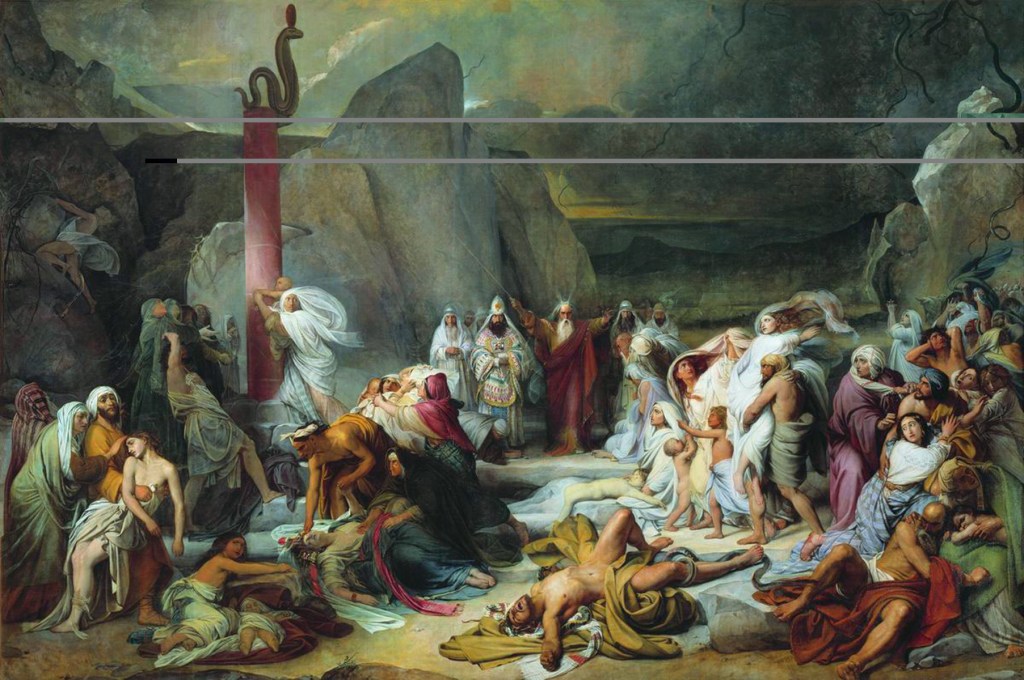
The Israelites set out from Mt. Hor by way of the Yam Suf to bypass the Edomites’ territory, but the people grew impatient on this journey. The people made statements against God and against Moses like “Why have you led us up from Egypt to die in the wilderness?” and “There is no bread or water!” and “We are sick and tired of this disgusting food.”
So the LORD sent poisonous snakes among the people and they were biting them so that many Israelites died. Then the people came to Moses and said, “We made a mistake when we spoke out against the LORD and against you! Pray for us to the LORD so that he will remove the snakes from us.” Moses prayed for the people.
Then the LORD said to Moses, “Make a poisonous serpent and put it on a pole. Whenever someone who’s been bitten looks at it, that person will live.” So, Moses made a bronze serpent and he set it up on a pole and whenever someone whom had been bitten and looked at the bronze serpent, he lived (Num 21.4-9).
There’s a lot I could say about this passage (and I’ll probably do that at some point). But the important thing for this (already too long) post is this: this was a tool that God had Moses make that had important, valuable, life-saving uses. God commanded it; Moses made it; it was useful and beneficial and it was good. But (most) things are not inherently good or bad, it the use thereof that makes them such. And, because of fallen human nature, many powerful tools are more likely to be used for evil rather than good purposes. The Bronze Serpent surely was such, as were the Israelites.
Powerful tools can easily become idols if we’re not careful. And if history has taught us one thing, it’s that it’s hard to be careful with powerful, useful things. The Israelites certainly failed in this regard. You see, I don’t know when they started to use that Bronze Serpent less as a tool and more of an idol, but I know it happened. Because, during the reign of Hezekiah, he doesn’t just remove high places, shatter sacred pillars, or cut down Asherah poles—he also must “break into pieces the bronze serpent that Moses had made, because up to then the Israelites had been making offerings to it, calling it Nehushtan” (2 Kgs 18.4).
The Bronze Serpent was a tool, but it became an idol when it was removed from its proper place and when people placed their trust in it. That serpent was treated like a god as soon as people started sacrificing to it. And, like the Bronze Serpent, AI is a tool made with human hands. It may have a place, it may have a use, and it may be helpful and it may be used within those contexts and with those restrictions. However, as soon as it is elevated and removed from the place of a servant, it will become a master. We don’t sacrifice to our tools.
And I get it, it’s easy to think “I’m in control. I’m using it, it’s not using me!” But we should look carefully into our mirrors to make sure that’s true and remains true. Because I’m not sure that we’re really doing a great job, there.
Keeping the Bronze Serpent in its Place
The reason that I’m blogging about this specifically is because I’ve been concerned by how I’m seeing AI used in church contexts—more and more I’m seeing preachers present articles and Facebook posts and tweets (and yes, sermons) that are the product of generative AI. I think that’s concerning. Not because all such things are bad in quality (although they often are), nor even because presenting thoughts as your own when they’re not (whether because one downloads a sermon from Executable Outlines or asks their preferred AI interface) is a form of intellectual theft—and we should always be wary of forbidden fruit. No, the element that I want to focus on today is that I think that using AI-written or drafted or outlined work is troubling because it elevates a product above the process.
Scripture and its presentation isn’t about a product—if it were, we should all just identify the “best” sermon someone has written and play that in every church each Sunday. Or go and download someone’s sermon every week and preach that. But presenting a ready-to-market product isn’t the goal Paul directs Timothy toward when he tells him to “do the work of an evangelist” (2 Tim 4.5) or to “be diligent to present yourself as one approved, a worker who doesn’t need to be ashamed but correctly teaching the word of truth” (2 Tim 2.15). Paul isn’t primarily talking about just getting a right answer, but interacting with the Word to an extent that we allow it to change us and change others. Often, AI provides an answer sheet that no longer requires us to work through the problems and learn things, ourselves.
Outsourcing our study to AI also skips the beauty of Scripture in a way that I don’t think we want. Do we listen to summaries of books or movies rather than watching or reading them? It would be far more efficient to just read a summary! But the benefit and beauty of art doesn’t come from reducing it to a summary, but from the full interaction of the experience. When we reduce process to efficiency, we remove the benefits that come to us from that process and its fallacious reasoning is exposed when we consider it elsewhere: Going straight to the answer sheet might get you through to a specific homework, but you’ll never learn the skills needed for future work. It becomes even more absurd when we apply the rational to other areas of personal betterment, growth, and appreciation. Imagine hearing, “Runners shouldn’t worry about running, cars are faster. Just drive!” “Why are you lifting weights? Don’t you know you’ll never be as strong as a forklift…” “Why would you want your child’s hand drawn picture, don’t you know it would be a lot quicker [and probably better looking!] for them to just print something from the computer?” And yet, I have heard the same about AI in the church.
We need to be really careful in determining what we’re using AI for, and what that thing needs. If we only need a product, the mechanized, thoughtless, speedy, precise, soulless mess of AI will always be better. And maybe you can or should use AI to help brainstorm ideas. But a computer cannot baptize an unbeliever; a computer cannot think; a computer cannot preach; I would not go to a technocrat church with a robot preacher. So give me the perfect gospel imperfectly preached someone made in the image of God rather than the soulless response of something made in the image of fallen humanity (“We build these things in our image…It’s, like, from Adam’s rib we made Eve. From humans, we made these A.I.s”).
Because, at its best, AI is still artificial intelligence—it has the facsimile of thought, but it does not think; it has the persona of a person, but it is not one; it has a mouth but cannot speak; eyes that cannot see, and ears but cannot hear. It always tells you what you want to hear; it will always get things wrong and act certain even when it’s wrong; it pretends to think even when it doesn’t; it cannot create, only replicate; and reliance on it removes your own ability to think thus reducing your own humanity.
So, by all means, use AI (I have and I’ll probably continue to do so for things), but be very careful how you do, lest it uses you and in doing so removes pieces of your humanity. If you find yourself merely adopting its outlines (or worse, its transcripts!), or copy-pasting it’s responses, that’s probably a good sign you’re on dangerous ground. And, by all means, give me the Word in the flesh that directs me to the Word Made Flesh so that we can become more like Him.
 Ben Neviim